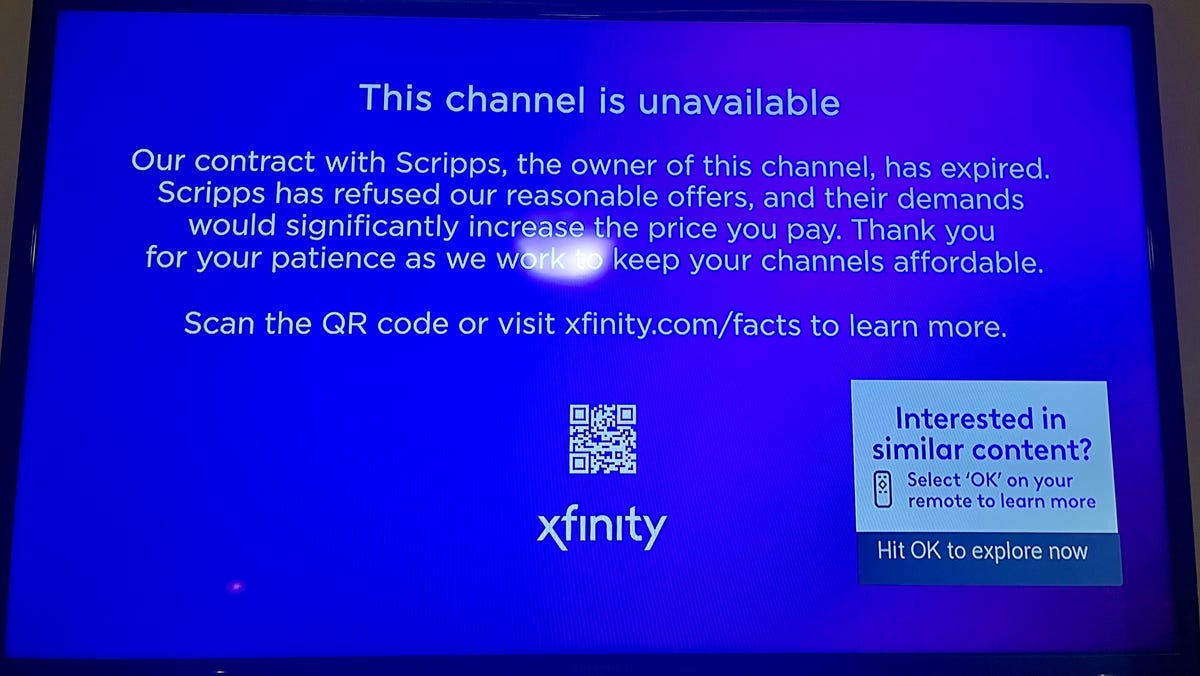
Macro-Economic Friction in Retransmission Consent
The suspension of Scripps Media programming across Comcast’s Xfinity platforms represents more than a localized service disruption; it is a manifestation of the structural decay within the traditional multichannel video programming distributor (MVPD) model. This impasse, impacting 40 stations across the United States, highlights the widening chasm between broadcaster operational costs and distributor margin protection. As linear viewership faces secular attrition, the negotiation for retransmission consent has evolved into a zero-sum game of cost-shifting and brand insulation.
Comcast has adopted a strategy of aggressive cost containment, positioning Scripps’ fee demands as a primary catalyst for consumer price inflation. By weaponizing its massive subscriber scale, Comcast seeks to disrupt the legacy model of escalating per-subscriber fees that has historically subsidized local broadcast infrastructure. Conversely, Scripps contends that these fees are non-negotiable capital requirements for maintaining essential local news and investigative journalism—assets that are increasingly expensive to produce as advertising revenues migrate toward algorithmic digital platforms.
Case Study: The Florida Panthers and the Sports Rights Vulnerability
The blackout’s intersection with the Florida Panthers’ 2024-25 season serves as a critical case study in the risks of the ‘RSN-to-OTA’ migration. The Panthers’ transition from Bally Sports Florida to Scripps Sports was intended to maximize accessibility through over-the-air (OTA) signals. However, this strategy revealed a latent vulnerability: by tethering professional sports to local broadcast stations, franchises remain beholden to the carriage stability of those stations within the dominant cable footprint. The disruption during the game against the Ottawa Senators underscores how distribution volatility can instantly disenfranchise a regional fan base.
This ‘distribution gap’ creates immediate downstream effects on sponsorship valuations and commercial reach. While the Panthers have redirected fans toward the ‘Panthers Plus’ direct-to-consumer (DTC) service, this platform lacks the passive discovery and massive reach of the integrated cable bundle. The situation demonstrates that while the broadcast model offers broader potential reach, its actualized reach is entirely contingent upon the gatekeeping power of MVPDs like Comcast.
Disintermediation and the Shift to OTA Antennas
In a tactical pivot toward disintermediation, Scripps has leveraged the blackout to promote its ‘Free TV Project,’ encouraging Xfinity subscribers to adopt digital antennas. This move attempts to bypass the cable interface entirely, reclaiming the direct relationship with the viewer. While technologically viable, this transition faces significant friction—specifically signal penetration issues and the loss of integrated DVR and navigation features that define the modern user experience.
Furthermore, the promotion of streaming applications on third-party hardware like Roku or Amazon Fire TV indicates a broader trend toward platform fragmentation. Broadcasters are increasingly training their audiences to seek content outside the traditional cable ecosystem. While this reduces reliance on any single distributor, it complicates the monetization of local advertising inventory, which relies on high-fidelity, consolidated audience data that cable providers typically control.
Regulatory Stasis and Future Industry Precedents
The dispute remains governed by federal mandates requiring ‘good faith’ negotiations, yet these regulations lack the mechanism to resolve fundamental disagreements over market value. The current standoff suggests that the traditional leverage held by broadcasters—the threat of losing local news and high-profile sports—is diminishing as distributors prioritize their broadband-first business models over declining video margins.
The resolution of the Comcast-Scripps dispute will likely set a financial floor for future negotiations involving other major station groups. If Comcast successfully minimizes fee increases, it will signal a decisive shift in power toward distributors. This outcome would force a fundamental re-evaluation of the broadcast business model, potentially leading to increased consolidation or a reduction in the scope of local news operations as the primary revenue engine of retransmission consent begins to stall.