
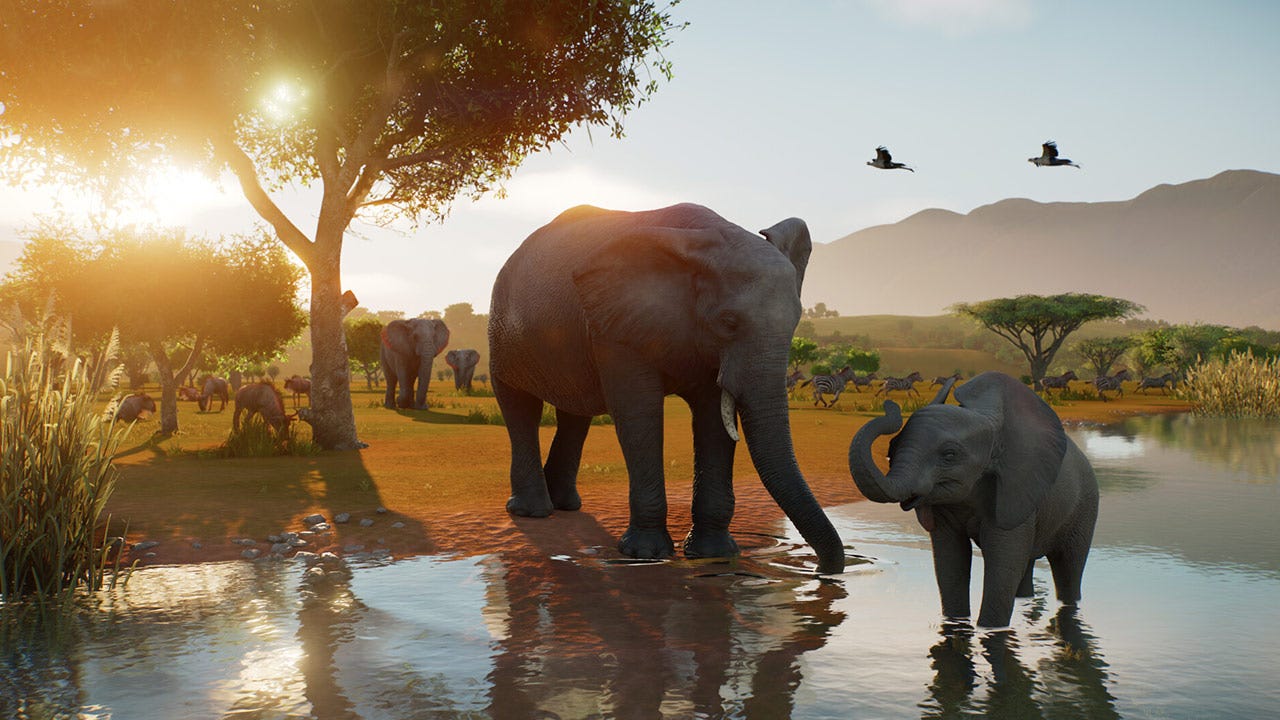
Systemic Evolution: Shifting from Amusement to Ecological Governance
Frontier Developments’ Planet Zoo 2 establishes an operational transition within the management simulation genre, elevating ecological preservation from an ancillary objective to a foundational mechanic. While foundational operational loops—enclosure architecture, staff logistics, and captive animal welfare—maintain continuity with its predecessor, the sequel reorients systemic success around biological sustainability rather than pure commercial extraction. This deliberate architecture contrasts sharply with the visitor-monetization focus of Planet Coaster and the crisis-mitigation containment models of Jurassic World Evolution.
By anchoring core gameplay strictly within real-world ecology, the title incorporates contemporary species catalogs—including heavily vulnerable and endangered taxa—into an algorithmic framework. Consequently, critical appraisals documented by international media outlets, including the British Broadcasting Corporation, emphasize the simulator’s efficacy in fostering systemic conservation literacy. Game mechanics that penalize excessive commercialization in favor of habitat equilibrium force players into modern resource-allocation models, bridging recreational simulation with conservation policy education.
Iterative Mechanics and Structural Limitations
From an architectural standpoint, Planet Zoo 2 utilizes an incremental development framework rather than an engine overhaul. Core responsibilities—workforce scheduling, biological quarantine, and barrier engineering—exhibit minimal friction for returning users, preserving continuity across established management loops. Micro-detailing and terrain customization tools have been significantly expanded, though they remain structurally elective. Players can successfully maintain viable ecological systems using baseline functional infrastructure, preserving access for casual demographics while accommodating hyper-optimized operational designs.
However, mechanics introduced specifically to represent open-range environmental stewardship exhibit clear systemic limitations. Documented critiques note that dedicated wildlife reserve mechanics lack the mechanical depth, behavioral interactivity, and systemic nuance present in traditional captive exhibits. This operational disparity indicates that while the thematic narrative emphasizes broader biosphere protection, the underlying codebase remains fundamentally tethered to zoological containment paradigms.
Taxonomic Scale and Facility Logistics
The title’s primary competitive differentiator is its catalog of over 130 species, which imposes layered logistical constraints on spatial zoning, biome climate regulation, and social group composition. The simulation explicitly distinguishes between large-scale macro-habitats and self-contained vivarium-style exhibit modules. This dichotomy dictates separate infrastructural demands, altering power distribution, veterinary routing, and crowd-flow dynamics across the facility.
By functioning as an interactive taxonomic registry, the game enforces compliance with real-world biological requirements through deterministic consequences. Sub-optimal environmental parameters, inadequate enrichment, or imbalanced sex ratios directly trigger institutional penalties, fiscal decline, and regulatory intervention. This design reinforces ecological fragility through functional gameplay constraints rather than passive pedagogical exposition.
Institutional Impact and Commercial Positioning
Media discourse surrounding Planet Zoo 2 frequently centers on the capacity of interactive entertainment to advance practical conservation goals. Modern zoological organizations rely heavily on public advocacy to fund captive breeding and reintroduction initiatives. By gamifying these exact ecological interventions, Frontier bridges theoretical preservation science and accessible ludic systems. The software repositioned animals from aesthetic assets to high-stakes ecological dependencies requiring calculated capital allocation.
Nonetheless, structural barriers remain between predictive simulation algorithms and field-level environmental variables. The game cannot replicate stochastic wild pressures, meaning its utility resides in public education and cognitive reframing rather than predictive scientific modeling. Commercial and critical consensus confirms, however, that Frontier has fortified a durable, highly dedicated market niche. By launching with a massive roster and stabilizing its core engine, Planet Zoo 2 confirms the commercial viability of high-complexity, conservation-centric simulation.

Photo by jamesmarkosborne on Pixabay.