
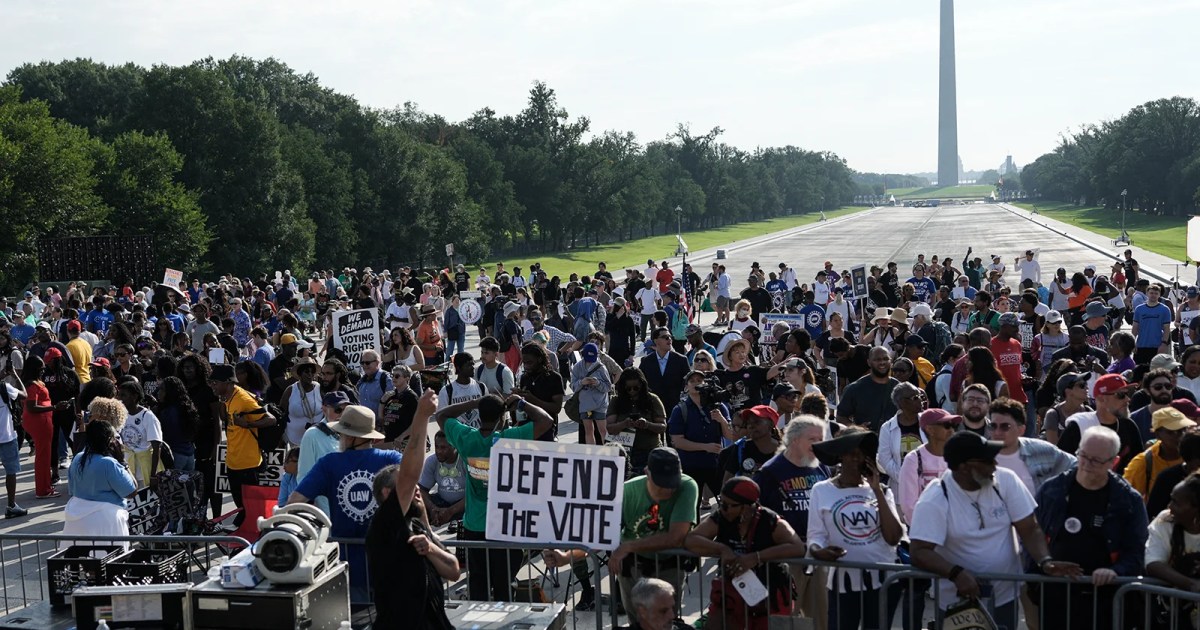
The 2026 March on Washington, held at the Lincoln Memorial, represents a critical synthesis of historical commemoration and modern political mobilization. Organized by the National Action Network (NAN) under the leadership of Rev. Al Sharpton, the assembly leverages the 63rd anniversary of the 1963 March to address acute institutional threats to the American electoral framework.
Tactical Mobilization and Institutional Friction
The ‘Defend the Vote’ rally serves as a high-leverage platform for a coalition of civil rights organizations and Democratic leaders to challenge the current administration’s influence on election integrity. By utilizing the Lincoln Memorial—a site of significant symbolic capital—organizers have amplified their critique of President Donald Trump’s executive posture and the legislative strategies of his allies. The timing is mathematically calibrated to influence the November midterm elections, where control of the House and Senate hinges on voter participation within a highly polarized environment.
Structural Erasure: The Impact of Partisan Gerrymandering
A primary catalyst for the 2026 mobilization is the structural impact of aggressive congressional redistricting. Post-census boundary adjustments in several Republican-led states have resulted in the dissolution of numerous Democratic-leaning and Black-majority seats. This systemic reconfiguration functions as a mechanism for long-term political consolidation, diluting the representative power of minority demographics and fundamentally altering the competitive map of the U.S. House of Representatives. Activists argue these shifts are not administrative formalities but deliberate efforts to neutralize the influence of urban and minority voting blocs.
Geopolitical Conflict and Domestic Macroeconomic Volatility
The domestic political landscape is increasingly dictated by the U.S. war with Iran, which has induced severe macroeconomic instability. The conflict has catalyzed a surge in energy costs and supply-chain disruptions, leading to sharp inflation in food and essential services. This economic backdrop has shifted the rally’s focus toward ‘intersectional justice,’ as figures like Senator Bernie Sanders and Representative Alexandria Ocasio-Cortez link civil rights protections to household financial stability. The rising cost of living creates a volatile electoral atmosphere where traditional civil rights messaging must compete with immediate economic grievances.
Institutional Divergence: The Lincoln Memorial vs. Jackson Hole
The rally stands in stark contrast to the concurrent economic summit in Jackson Hole, featuring monetary policy figures like Kevin Warsh. While Washington focuses on the democratization of political power, Jackson Hole prioritizes high-level fiscal stabilization and managing the debt-to-GDP ratios exacerbated by the Iran conflict. This divergence highlights a deepening rift between grassroots social demands and elite-level economic management, reflecting the broader polarization of the American political-economic complex.
Projected Consequences for Democratic Legitimacy
The persistence of voter suppression allegations and the perceived erosion of minority representation present a risk to the perceived legitimacy of the 2026 midterm results. If these structural barriers remain unaddressed, the resulting legislative composition may be viewed as the byproduct of a compromised system, further degrading public trust in federal institutions. The ‘Defend the Vote’ rally serves as an operational declaration by civil rights leaders to transition from symbolic protest to sustained legal and electoral monitoring, ensuring that the 2026 cycle is defined by participation rather than exclusion.

Photo by Veronika_Andrews on Pixabay.