The matchup between the San Francisco Giants and the Arizona Diamondbacks on May 25, 2026, highlights the intensifying competitive and economic pressures within the National League West. Arizona enters third in the division at 28-24, while San Francisco trails in fourth at 22-31. This divisional gap subjects both organizations’ front-office strategies to rigorous scrutiny as they enter the high-leverage middle third of the Major League Baseball season.
Divisional Standings and Capital Allocation
Recent performance trajectories have polarized the competitive outlook for both clubs. Arizona has established positive momentum following a 6-1 homestand, capped by a 9-1 run-differential victory over the Colorado Rockies. This stretch validated the Diamondbacks’ offensive efficiency and optimized their home-field positioning within the wild-card and divisional standings.
Conversely, San Francisco’s persistent volatility has generated critical questions regarding their roster architecture. A recent series sweep by Arizona in Phoenix exposed structural gaps, forcing stakeholders to evaluate the marginal efficiency of the Giants’ high-payroll player-acquisition and development frameworks. Prolonged underperformance threatens both fan engagement and the financial return on investment (ROI) of recent free-agent commitments, whereas Arizona’s position above the .500 threshold stabilizes their local television viewership, ticket demand, and corporate partnership valuations.
Organizational Governance and the Rebuild Constraint
Media speculation regarding a potential “soft rebuild” prompted public clarification from Buster Posey, a key figure in the Giants’ institutional leadership. Posey rejected the rebuild narrative, attributing the team’s standing to roster underperformance rather than a deliberate strategic retreat.
This public stance carries significant institutional consequences. By denying a rebuild, leadership commits the front office to an immediate win-now mandate. This strategic bottleneck limits managerial flexibility ahead of the trade deadline, restricting the organization’s ability to liquidate assets for prospect capital without contradicting its public commitments. Consequently, short-term performance pressure on the active roster and coaching staff is significantly magnified.
Rotational Variance: Starting Pitching Matchup
The series opener features a stark divergence in starting pitching efficiency. San Francisco starts Landen Roupp, who offers strong rotational value with a 5-4 record, a 3.27 ERA, a 1.15 WHIP, and 61 strikeouts. Roupp’s ability to generate swing-and-miss outcomes and limit base paths traffic represents a crucial operational advantage for the home team.
Arizona counters with veteran Merrill Kelly (4-3, 5.71 ERA, 1.51 WHIP). Kelly’s elevated metrics indicate vulnerability to hard contact and high-traffic innings. However, his veteran utility remains central to the Diamondbacks’ road strategy as they attempt to stabilize their pitching depth away from Phoenix.
Lineup Metrics and Run-Conversion Efficiency
Despite their sub-.500 record, the Giants’ collective .247 batting average ranks seventh in MLB, indicating that their primary offensive challenge is run conversion rather than pure contact. A recent two-game sweep of the Chicago White Sox, in which they generated 18 combined runs, suggests a potential upward regression toward mean efficiency.
Individually, Casey Schmitt has provided primary isolated power for San Francisco, registering 21 extra-base hits (nine doubles, one triple, and 11 home runs). Harrison Bader has contributed short-term surplus value, batting 10-for-37 (.270) with three doubles, four home runs, and 10 RBIs over his last ten games. Additionally, Rafael Devers’ offensive metrics are trending back toward his established career baselines.
Arizona’s offense relies on high-impact individual production. Corbin Carroll enters after a key four-hit game against the Rockies, while Ketel Marte anchors the lineup with eight home runs and a slugging percentage in the .400 range. The ability of these primary hitters to exploit Roupp’s pitching matchup will dictate Arizona’s offensive ceiling.
Bullpen Leverage and Ballpark Factors
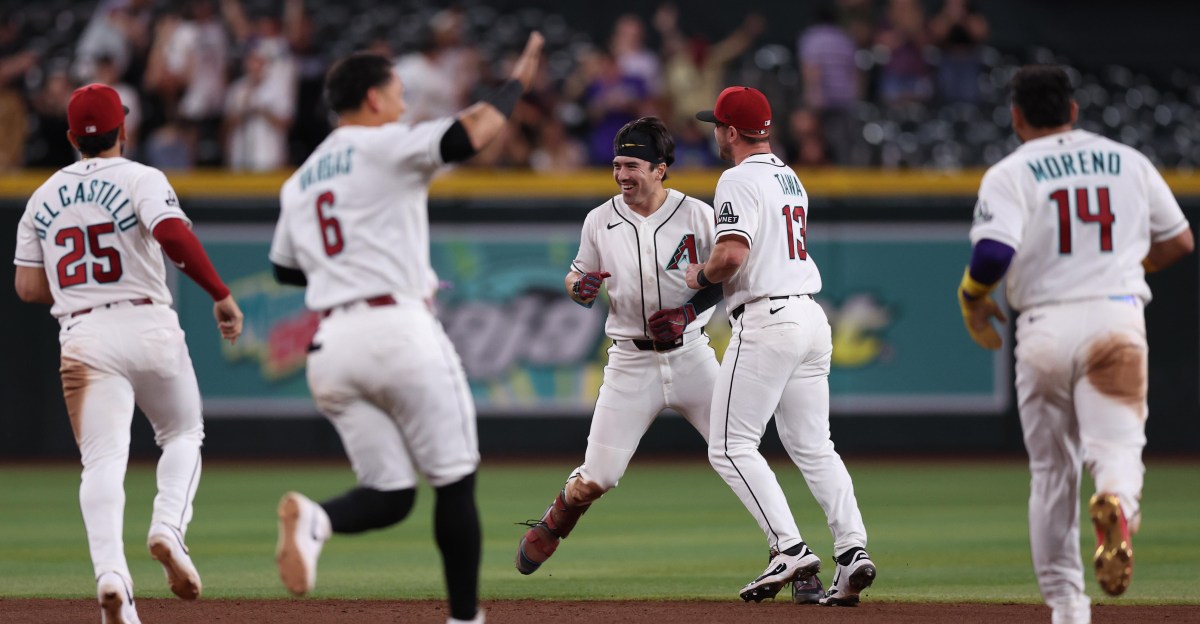
Late-game execution remains a critical variable, as demonstrated by the previous head-to-head series in Phoenix. The Diamondbacks secured a 5-3 walk-off victory after the Giants surrendered a 3-1 lead in the ninth inning. Blown leads of this nature compound bullpen fatigue, limit tactical flexibility, and strain late-inning defensive alignments.
Venue dynamics at Oracle Park introduce further strategic constraints. San Francisco has struggled to establish home-field leverage, posting a modest 12-13 record at home. While Arizona’s 10-14 road record highlights their own travel vulnerabilities, their organizational profile is highly optimized for pitcher-friendly environments; the Diamondbacks hold a 14-4 record in contests where their pitching staff prevents home runs. In a stadium that historically suppresses home runs, Arizona’s ability to limit extra-base hits could decide the series.