Market Realigns Amidst U.S.-Iran Ceasefire Announcement
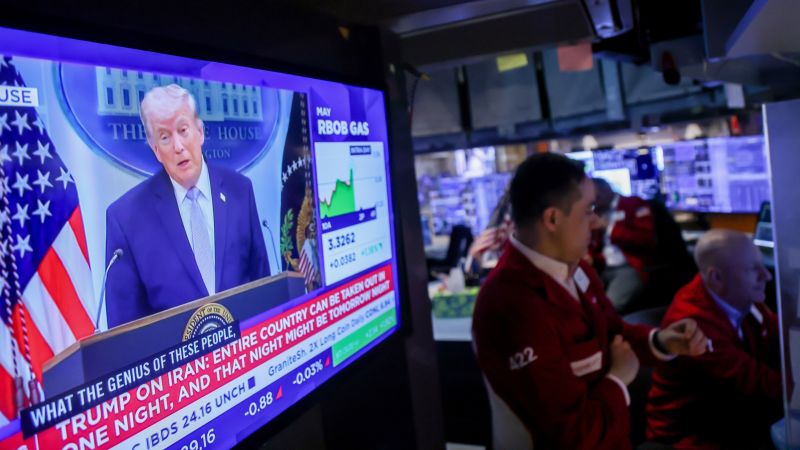
Global financial markets reacted with significant volatility to President Donald Trump’s announcement of a conditional two-week ceasefire with Iran. Oil prices experienced a sharp decline, with U.S. crude futures falling over 15% to below $95 a barrel. This drop indicates that market pricing had heavily incorporated supply disruption risks and a significant risk premium related to the Strait of Hormuz.
The rapid fall in oil prices is attributed to the renewed prospect of unimpeded transit through the Strait of Hormuz, a critical chokepoint for approximately 20% of global oil supply. The perceived de-escalation of geopolitical tension has effectively reduced the war risk premium embedded in crude valuations, underscoring the market’s sensitivity to supply-side shocks and its rapid recalibration based on perceived stability.
Equities Surge as Geopolitical Fears Subside
Concurrently, global stock markets saw a robust rally. Dow futures surged approximately 2.2%, while S&P 500 and Nasdaq futures posted gains of 2.4% and 3%, respectively. This broad-based upward movement across major U.S. indices reflects investor relief from the potential economic repercussions of escalated conflict.
Asian markets mirrored this sentiment. Japan’s Nikkei 225 rose 5.4%, South Korea’s Kospi gained 6.9%, and Hong Kong’s Hang Seng increased by 2.8%. These widespread gains suggest a global reassessment of risk, with investors favoring riskier assets as immediate geopolitical threats appear to recede, signaling anticipation of a more stable economic outlook.
European Markets Lead Gains on Ceasefire Deal
European stocks opened sharply higher, with the pan-European Stoxx 600 index up 3.8%. This broad market uplift, excluding the oil and gas sector, highlights a positive market-wide reaction to the conditional ceasefire. Sectors previously weighed down by supply chain anxieties and inflation fears are now positioned for potential recovery.
Specific sectors demonstrated strong performance: autos, miners, and travel stocks each rose 5.8%, with travel stocks climbing an additional 1.5% to 7.3%. The significant gains in the travel sector, which is highly sensitive to global stability and energy prices, indicate market anticipation of improved consumer spending and industrial activity driven by lower energy costs.
Major European indices also saw substantial increases: the U.K.’s FTSE 100 added 2.4%, Germany’s DAX rose 4.8%, France’s CAC 40 was up 4.1%, and Italy’s FTSE MIB advanced 3.6%. This synchronized movement underscores the interconnectedness of global markets and the profound impact of geopolitical stability on investor confidence.
Corporate Earnings Reflect Operational Impacts and Trading Resilience
Shell’s earnings report offered insight into operational disruptions, noting a decrease in LNG production from 948,000 boe in Q4 2025 to 880,000-920,000 in Q1 2026. Despite these production challenges, the company reported “significantly higher” oil trading profits, illustrating how market volatility can create profitable opportunities for sophisticated energy traders.
This contrast highlights the bifurcated nature of the energy market during geopolitical stress. While physical supply chains faced disruptions, heightened price volatility created lucrative avenues for trading operations, demonstrating the adaptive strategies of major energy firms.
Lingering Uncertainty and Market Outlook
Despite immediate market optimism, analysts caution about long-term implications. The effectiveness of the ceasefire in ensuring sustained opening of the Strait of Hormuz and a lasting resolution to the underlying conflict remain key concerns. Future price movements will depend on the durability and scope of the U.S.-Iran agreement.
Bob McNally, founder of Rapidan Energy Group, noted that while the market is eager for positive news, the actual opening of the Strait of Hormuz remains to be seen. This highlights a disconnect between immediate market sentiment and geopolitical realities. The sustainability of the rally hinges on concrete actions translating into stable supply chains.
Historical context suggests that while ceasefires offer temporary relief, underlying structural issues can lead to price reversion. Current U.S. crude futures remain above pre-war levels, indicating a persistent risk premium. The market is pricing in caution, anticipating a protracted path to sustained peace and stable energy flows.
A sustained period of lower oil prices would alleviate global inflationary pressures, potentially boosting consumer spending and corporate investment. Conversely, any ceasefire breakdown could trigger another spike in energy costs. The current market reaction reflects a speculative bet on stability, but underlying geopolitical fragility necessitates vigilance.
The performance of cyclical sectors like autos, miners, and travel, highly sensitive to energy costs and global economic health, indicates a broader market recalibration. Investors anticipate a more favorable operating environment driven by lower input costs and increased consumer confidence.
The operational impact on companies like Shell, evidenced by reduced LNG production, underscores persistent physical and logistical challenges. While trading operations can capitalize on volatility, core business operations remain vulnerable to geopolitical disruptions, highlighting the complex interplay between financial markets and tangible energy realities.
Long-term implications for the global energy landscape remain uncertain. A sustained de-escalation could usher in a period of lower energy prices. However, the region’s history suggests a complex path forward, with the market remaining sensitive to diplomatic or military posture shifts. The current rally represents a hopeful, yet potentially fragile, reassessment of global economic risks.
Strategic decisions by governments and international bodies in the coming weeks will be crucial. Diplomatic efforts to solidify the ceasefire and address root causes are paramount. The market’s ability to sustain its upward trajectory depends on the credibility and effectiveness of these peace-building initiatives.
The financial leverage of the Strait of Hormuz on global trade is substantial. Its critical role in oil transit means any disruption has immediate and far-reaching economic consequences. The market reaction demonstrates the profound impact that even the prospect of unimpeded passage has on global capital flows and investor sentiment.
The rally in equity markets, with futures jumping significantly, illustrates the market’s capacity for rapid repricing based on perceived risk shifts. This suggests investor sentiment had been overly pessimistic, and the ceasefire provided a catalyst for optimism. However, the sustainability of this optimism will be tested by the actual implementation and long-term viability of the peace agreement.
Competitive implications for energy producers are also significant. Lower oil prices could favor higher-cost producers or lead to reduced investment in new exploration, impacting long-term supply. The current market is characterized by flux, requiring significant strategic considerations for all energy sector players.
The institutional response from central banks and international financial institutions will be a key factor. Sustained lower inflation could grant central banks greater monetary policy flexibility. However, any resurgence of inflation due to renewed conflict would necessitate a hawkish stance, potentially dampening economic growth. The situation presents a complex policy challenge.
The exposure of global supply chains to geopolitical risk has been starkly highlighted. Potential disruptions in critical transit routes underscore the need for greater resilience and diversification in global trade networks. The current market reaction emphasizes the interconnectedness of geopolitical stability and economic prosperity.
Capital movement observed in equity market rallies suggests a reallocation away from safe-haven assets towards growth-oriented sectors. This shift indicates a renewed appetite for risk, driven by the prospect of a more stable global economic environment. Future capital flows will depend on the evolving geopolitical landscape.
The performance leverage in the oil market, with prices dropping sharply, demonstrates the immediate impact of supply-side expectations on commodity valuations. The market’s rapid discounting of future supply availability underscores how efficiently information is incorporated into pricing mechanisms.
Strategic decisions by the U.S. and Iran in the coming weeks will profoundly impact global energy markets and geopolitical stability. The ceasefire’s success in paving the way for enduring peace will critically determine future market performance and economic outlook. The current market reaction is a hopeful indicator, but the path forward remains subject to significant uncertainties.
The competitive positioning of energy companies will be reshaped by the evolving price environment. Efficient operations and diversified portfolios will be key. Current market volatility necessitates long-term strategic planning for sustained profitability and market relevance.
Institutional frameworks governing international relations and trade will be tested by the ceasefire’s durability. The effectiveness of multilateral diplomacy and key global actors’ commitment to de-escalation are critical for translating this truce into lasting peace. The market’s optimistic response underscores the global desire for stability, but underlying complexities require sustained diplomatic efforts.